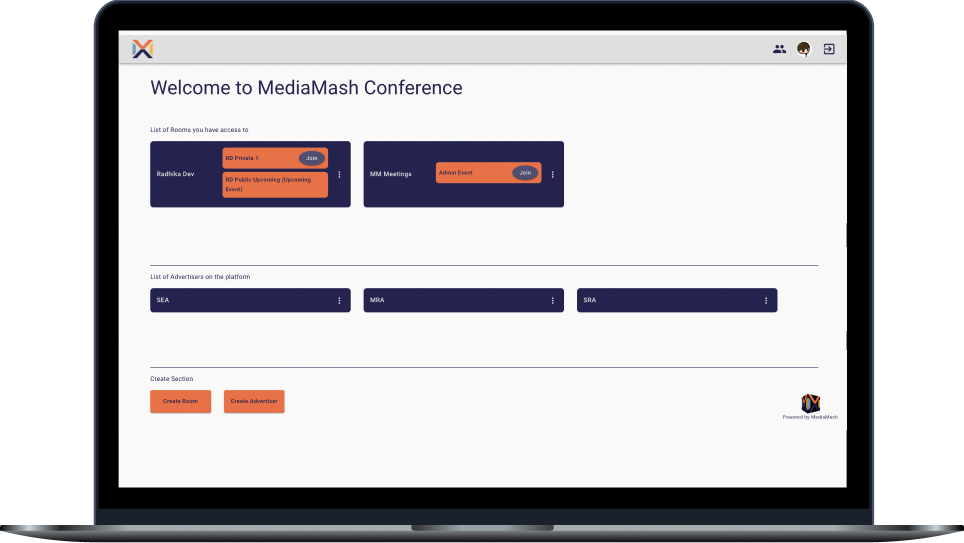
Ajackus partnered with Buildly — an open-source platform company — to design and build MediaMash, a cloud-native web conferencing platform integrating the Janus WebRTC server with Kubernetes-based containerised deployment, delivering 100+ guest capacity and 125 concurrent playback sessions in 5.5 months.

Engagement Model
Team Augmentation
Your team, supercharged — every Ajackus engineer comes AI-native, shipping 40–60% faster from day one
Managed Delivery
Tell us the problem. We handle everything — discovery, architecture, build, testing, deployment — at AI speed
BOT Model
We build your offshore engineering center with AI-trained teams, operate it to maturity, then transfer ownership to you
Expertise
AI Development
Custom AI agents, LLM integrations, RAG pipelines, and AI enablement — from strategy to production
Web Development
Enterprise web applications built with AI-augmented engineering for 40-60% faster delivery
Mobile Development
Native and cross-platform mobile apps built at AI pace with rigorous automated quality
DevOps
Infrastructure that scales automatically, deploys safely, and costs less
Low-Code/No-Code
Airtable, Glide, Shopify, and WordPress solutions with AI automation layers — built in days
Data Analytics
Turn raw data into decisions that drive revenue — 80% faster with AI-assisted analytics
UI/UX Design
User-centered interfaces designed with AI-powered speed — 3x faster iteration, sharper insights


How Buildly Delivered MediaMash — a Containerised Web Conferencing Platform Supporting 125 Concurrent Sessions — in 5.5 Months with Kubernetes and WebRTC
Services
Cloud Infrastructure Integration
Custom Application Development
DevOps and Platform Engineering
Technologies


5.5 Mo
Full Platform Delivery
125
Concurrent Playback Sessions
100+
Guests Per Event
Overview
Executive Summary
Client
Challenge
Goals
Journey
Results
Technology
Takeaways
FAQ
Executive Summary
The Problem
The COVID-19 pandemic created urgent enterprise demand for web conferencing, but existing platforms could not be self-hosted, containerised, or integrated into open-source, cloud-native architectures — leaving Buildly without a conferencing solution that matched its microservices-first technology philosophy or its clients’ need for control, scalability, and infrastructure portability.
The Solution
Ajackus built MediaMash — a full-stack, containerised web conferencing platform — by integrating the Janus open-source WebRTC server with Kubernetes-based deployment, implementing Infrastructure as Code using Terraform and Helm, and engineering a microservices architecture deployable across both AWS and GCP with full multi-device and multi-browser compatibility.
The Result
MediaMash launched as a production-ready platform supporting 100+ guests per event and 125 concurrent playback sessions, delivered in 5.5 months. The platform was critically acclaimed in the market, and its commercial validation led directly to VinoShares becoming a subsequent Buildly client.
Client
Buildly is an open-source platform company focused on enabling developers and enterprises to build and deploy containerised, cloud-native applications without vendor lock-in. Its approach centres on microservices architecture, infrastructure portability, and open standards — principles that shaped every aspect of the MediaMash brief. When the COVID-19 pandemic accelerated demand for enterprise-grade remote conferencing, Buildly identified a gap: no available web conferencing platform was designed for self-hosted, containerised deployment with the operational controls that enterprise clients require. Buildly engaged Ajackus to build MediaMash from the ground up to fill that gap.
| Industry | Open Source / Web Conferencing |
| Platform Architecture | Cloud-native, containerised, microservices |
| Cloud Support | AWS and GCP |
| Engagement Type | Full-Ownership Product Build (Managed Delivery) |
| Delivery Timeline | 5.5 months from engagement start to production |
Challenge
The Bottom Line
Buildly needed a web conferencing platform built to open-source principles — containerised with Kubernetes, deployable across clouds, controlled entirely by the operator — capable of hosting 100+ guest events with live-streaming, and delivered fast enough to capture the pandemic-driven surge in enterprise remote-working demand.
When the COVID-19 pandemic forced enterprises to operate remotely, demand for web conferencing tools surged — but the solutions available shared a fundamental flaw: they were centralised, proprietary, and impossible to self-host or control at the infrastructure level. Research at the time showed that 78% of corporate companies could not effectively host and manage large-scale virtual conferences or live-stream them to their required audience sizes. For Buildly, whose entire platform philosophy is built on open-source, containerised, cloud-portable infrastructure, this gap was not just a market opportunity — it was a direct challenge to address with the principles it already stood for.
The brief given to Ajackus was unusually constrained: build a production-ready web conferencing platform that could be containerised, replicated across environments, and operated with full enterprise control — without depending on any proprietary conferencing vendor. Every architectural decision had to remain true to Buildly’s open-source ethos.
No Self-Hostable Enterprise Conferencing Solution
Available conferencing platforms in 2020 were either consumer-grade tools with limited administrative control, or enterprise platforms requiring significant proprietary lock-in. No production-ready, self-hostable conferencing system existed that could be deployed inside Buildly’s containerised architecture and operated with full operator control over rooms, hosts, participants, and live-stream configuration.
Containerisation Architecture Complexity
Integrating a real-time WebRTC-based conferencing system into a Kubernetes-managed microservices environment is architecturally non-trivial. WebRTC’s reliance on direct peer connections, media servers, and network traversal (STUN/TURN) presents specific challenges when abstracted behind container networking. The Ajackus team had to engineer a deployment model where the Janus WebRTC server operated correctly and performantly within Kubernetes pod constraints, while maintaining the isolation and scalability benefits of containerised architecture.
Enterprise Scale and Administrative Control Requirements
Enterprise conferencing at meaningful scale — 100+ guests per event, live-streaming to external audiences, advertisement display, and host management — requires a different engineering approach from building a standard video call. The platform needed granular administrative controls: room creation and management, host permissions, stream configuration, and real-time monitoring — all accessible to the operator without requiring engineering intervention for each event.
Infrastructure Replication for Open-Source Distribution
A core requirement of the Buildly model is that environments must be replicable — clients should be able to stand up their own instances of the platform without bespoke infrastructure work for each deployment. This demanded Infrastructure as Code from the outset, not as a later optimisation. Terraform and Helm configurations had to be production-quality and documented well enough to enable reliable environment replication by operators who had not built the original system.
Multi-Platform and Multi-Device Compatibility
Enterprise conference participants join from a wide range of devices and environments: desktop browsers, mobile phones, edge devices, and varying operating systems. The platform had to deliver a consistent, functional conferencing experience across this full matrix of device types and browser configurations — a requirement that significantly increased the testing surface and demanded careful abstraction of the media-handling layer.
Goals
The MediaMash build required a platform that embodied open-source principles at the infrastructure level whilst delivering enterprise-grade performance and control at the application level.
| Goal | Success Criterion |
|---|---|
| Build containerised web conferencing platform | Kubernetes-orchestrated deployment operational with Janus WebRTC server integrated |
| Support enterprise event capacity | 100+ guests per event and 125 concurrent playback sessions at launch |
| Implement Infrastructure as Code | Terraform and Helm configurations enable one-command environment replication across deployments |
| Enable multi-cloud deployment | Platform deployable and operational on both AWS and GCP without code changes |
| Deliver administrative conference controls | Host management, room configuration, live-streaming, and advertisement display fully operator-controlled |
| Achieve cross-platform compatibility | Full functionality across edge devices, smartphones, major browsers, and operating systems |
| Deliver within commercial timeline | Production-ready platform launched within 5.5 months of engagement start |
Journey
The Ajackus team took end-to-end ownership of the MediaMash platform — from architecture design through to production deployment — operating as the core engineering team throughout the 5.5-month engagement. The Ajackus team structured the build around four parallel workstreams: WebRTC media server integration, Kubernetes containerisation, infrastructure automation, and application feature development. Rather than treating infrastructure as a deployment concern to be addressed after the application was built, the Ajackus team designed infrastructure and application in lockstep — a deliberate decision that ensured the containerised architecture constraints were embedded in the platform’s design rather than retrofitted.
WebRTC Integration with Janus Media Server
The foundation of the MediaMash platform is the Janus open-source WebRTC server, selected by the Ajackus team for its flexibility, active community, and suitability for containerised deployment. Integrating Janus into a Kubernetes environment required resolving the specific network traversal challenges that WebRTC presents in containerised contexts — STUN/TURN configuration, media port management, and peer connection negotiation within pod networking constraints. The Ajackus team engineered the Janus deployment to maintain the full real-time audio and video performance characteristics expected of enterprise conferencing, without sacrificing the scalability and isolation benefits of Kubernetes orchestration.
Kubernetes-Based Containerised Architecture
The Ajackus team designed MediaMash as a microservices platform orchestrated by Kubernetes, with Docker as the containerisation layer for each service component. This architecture was chosen for its alignment with Buildly’s open-source philosophy and for its practical consequence: each component of the conferencing platform — media server, room management, host controls, live-streaming — is independently deployable, scalable, and maintainable. The Kubernetes orchestration layer ensures that the platform can sustain 125 concurrent playback sessions by routing load across available container instances without manual intervention.
Infrastructure as Code with Terraform and Helm
A defining requirement of the Buildly engagement was environment replicability: operators needed to be able to stand up their own MediaMash instances without bespoke infrastructure work. The Ajackus team implemented the full infrastructure layer using Terraform for cloud resource provisioning and Helm for Kubernetes application packaging. This combination allows a new MediaMash deployment to be instantiated on either AWS or GCP through a structured, version-controlled process — eliminating the manual configuration effort that typically makes self-hosted conferencing platforms impractical to distribute at scale.
Conference Feature Development and Multi-Platform Testing
Alongside the infrastructure and media server work, the Ajackus team built the full set of conference management features: online conference hall creation and host management, meeting environment controls and configurations, global live-streaming capability, and advertisement display integration. Each feature was built with operator control as the primary design principle — ensuring that conference hosts can manage events without engineering support. The Ajackus team conducted systematic cross-platform testing across edge devices, smartphones, and the major browser and operating system combinations to ensure consistent performance across the full range of participant device types.
Results
MediaMash launched as a production-ready web conferencing platform within 5.5 months, delivering enterprise-scale event capacity, full operator control, and cloud-portable infrastructure — earning critical market acclaim and validating Buildly’s open-source conferencing approach.
5.5 Mo
From Engagement Start to Production
125
Concurrent Playback Sessions Supported
100+
Guests Per Event at Launch
What went well:
Operational Achievements
- Full production platform — Kubernetes-orchestrated, multi-cloud, enterprise conference-capable — delivered in 5.5 months from engagement start
- Host management, room configuration, live-streaming, and advertisement controls operational from day one, allowing Buildly to run events without any engineering dependency
- Environment replication enabled via Terraform and Helm, so new MediaMash instances can be stood up on AWS or GCP through a structured, repeatable process
- Cross-platform compatibility validated across edge devices, smartphones, and major browser and operating system combinations at launch
Technical Achievements
- Janus WebRTC server integrated into Kubernetes pod networking with full real-time audio and video performance, resolving the container-networking challenges inherent to WebRTC deployment
- 125 concurrent playback sessions supported by Kubernetes-managed horizontal scaling across containerised service components
- Microservices architecture ensures each platform component — media server, room management, streaming, host controls — is independently deployable and scalable
- Full Infrastructure as Code implementation with Terraform and Helm enables cloud-portable, version-controlled environment replication across AWS and GCP
- Docker containerisation of all platform services provides consistent, environment-agnostic deployment with no dependency on host-level configuration
Business Validation
- MediaMash was critically acclaimed and well received by the market at launch, validating both Buildly’s open-source conferencing thesis and Ajackus’s delivery execution
- The platform’s commercial success directly contributed to VinoShares becoming a subsequent Buildly client — a concrete business-outcome signal of the engagement’s impact
- The open-source, self-hostable architecture positions MediaMash as a differentiated enterprise conferencing option in a market dominated by proprietary, vendor-controlled platforms
Why It Worked
Infrastructure and Application Designed Together
Most platform builds treat infrastructure as a deployment concern — something addressed after the application is built. The Ajackus team inverted this: infrastructure design, Kubernetes architecture, and Terraform/Helm configuration were built in lockstep with application development from the first sprint. This is what made it possible to deliver a containerised, multi-cloud-deployable platform in 5.5 months rather than discovering infrastructure constraints late in the build cycle.
Open-Source Selection Driven by Fit, Not Familiarity
The decision to use Janus as the WebRTC server was deliberate — not simply the most familiar option, but the one most architecturally suited to containerised deployment and open-source distribution. The Ajackus team evaluated the technical constraints of containerising a WebRTC media server before selecting Janus, then engineered the specific network configuration required to make it perform correctly within Kubernetes pod networking. This fit-first approach to technology selection is what made the media infrastructure reliable from launch.
Replicability as a First-Class Design Requirement
Buildly’s model requires that clients can self-host platform instances — which means environment replication cannot be an afterthought. The Ajackus team treated Infrastructure as Code not as a convenience but as a core product deliverable, ensuring Terraform and Helm configurations were production-quality and portable from the outset. The result is a platform that Buildly can distribute to enterprise clients without bespoke infrastructure work for each deployment — a commercial capability that was built in, not added on.
Frequently Asked Questions
How does the MediaMash platform support 125 concurrent playback sessions?
MediaMash’s capacity for 125 concurrent playback sessions is a direct product of its Kubernetes-orchestrated microservices architecture. The Janus WebRTC media server and each platform service component are deployed as containerised workloads managed by Kubernetes, which handles horizontal scaling across available instances as concurrent session load increases. The Ajackus team designed the platform’s resource allocation and networking configuration specifically to sustain this level of simultaneous sessions without performance degradation — validated through load testing before the production launch.
Why was Janus chosen as the WebRTC server for MediaMash?
The Ajackus team selected Janus because it is the open-source WebRTC server best suited to containerised, cloud-native deployment — a non-negotiable requirement for Buildly’s platform model. Janus’s plugin-based architecture provided the flexibility to implement conference room management, live-streaming, and media controls without requiring custom forks of the core server code. The primary engineering challenge was resolving the STUN/TURN and media port configuration required for Janus to operate correctly within Kubernetes pod networking, which the Ajackus team addressed through specific network policy and service configuration designed for the containerised context.
How does Infrastructure as Code make MediaMash deployable across AWS and GCP?
The Ajackus team implemented the full MediaMash infrastructure layer using Terraform for cloud resource provisioning and Helm for Kubernetes application packaging. Terraform configurations define the cloud infrastructure (networking, compute, storage) in a provider-agnostic way, allowing the same configuration to be applied on both AWS and GCP. Helm charts package the Kubernetes deployment specifications for each MediaMash service component into a version-controlled, parameterised format. Together, these tools allow a new MediaMash instance to be stood up on either cloud provider through a structured, repeatable process — which is the foundation of Buildly’s self-hosted distribution model.
How quickly can Ajackus deliver a production-ready cloud-native platform?
The MediaMash engagement demonstrates Ajackus’s ability to deliver a production-grade, Kubernetes-orchestrated, multi-cloud platform — with WebRTC integration, Infrastructure as Code, and full conference management features — within 5.5 months. Ajackus operates across three engagement models: Team Augmentation, Managed Delivery, and Build-Operate-Transfer. For platform builds of MediaMash’s complexity, Ajackus typically onboards a scoping team within two weeks of engagement confirmation. Timeline depends on scope, but 4–8 months is typical for a full-stack cloud-native product of this type.
Can Ajackus build platforms designed for open-source distribution and self-hosting?
Yes. The MediaMash build was specifically designed for open-source distribution — every architectural decision, from Kubernetes orchestration to Terraform/Helm Infrastructure as Code, was made to enable Buildly’s clients to self-host their own instances without bespoke infrastructure work. The Ajackus team has experience building platforms that must be portable, replicable, and operable by organisations that did not build the original system. This requires treating environment replication and Infrastructure as Code as first-class product deliverables, not post-build conveniences.
What engagement model did Ajackus use for the MediaMash build?
Ajackus operated under its Managed Delivery model for the MediaMash engagement — functioning as the end-to-end engineering team rather than supplementing an existing in-house function. Buildly brought deep open-source platform expertise and product direction; Ajackus owned architecture, engineering, containerisation, infrastructure automation, and production delivery. This model is suited to product builds where the client has domain expertise but requires a dedicated engineering partner to own the full technical execution. Ajackus manages sprint planning, technical decisions, and quality assurance within this model, with the client retaining full visibility and approval at each milestone.


Let’s Build your Project Together