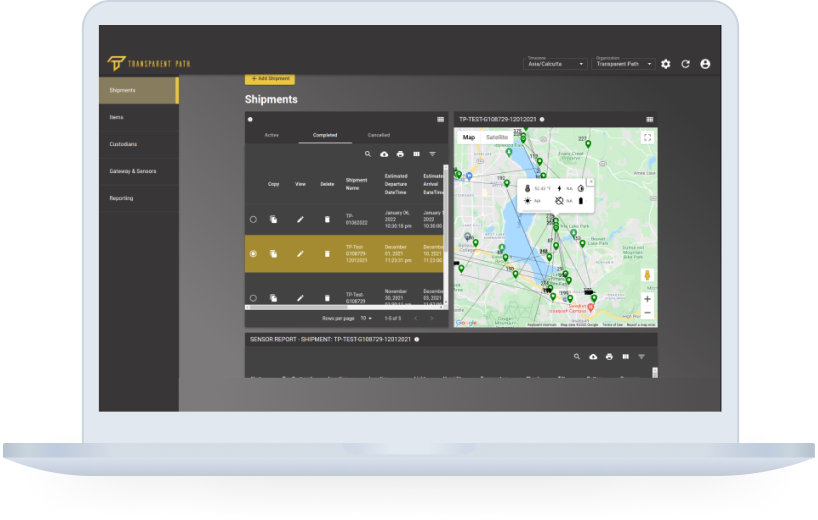
Ajackus partnered with Transparent Path — via a Buildly open-source collaboration — to design and build a cloud-native, sensor-integrated logistics platform that tracks perishables shipments in real time across producers, processors, wholesalers, and retailers, delivering automated deviation alerts and consortium-wide risk management through a Kubernetes-orchestrated microservices architecture on AWS and GCP.

Engagement Model
Team Augmentation
Your team, supercharged — every Ajackus engineer comes AI-native, shipping 40–60% faster from day one
Managed Delivery
Tell us the problem. We handle everything — discovery, architecture, build, testing, deployment — at AI speed
BOT Model
We build your offshore engineering center with AI-trained teams, operate it to maturity, then transfer ownership to you
Expertise
AI Development
Custom AI agents, LLM integrations, RAG pipelines, and AI enablement — from strategy to production
Web Development
Enterprise web applications built with AI-augmented engineering for 40-60% faster delivery
Mobile Development
Native and cross-platform mobile apps built at AI pace with rigorous automated quality
DevOps
Infrastructure that scales automatically, deploys safely, and costs less
Low-Code/No-Code
Airtable, Glide, Shopify, and WordPress solutions with AI automation layers — built in days
Data Analytics
Turn raw data into decisions that drive revenue — 80% faster with AI-assisted analytics
UI/UX Design
User-centered interfaces designed with AI-powered speed — 3x faster iteration, sharper insights


How Transparent Path Built a Real-Time IoT Tracking Platform for Perishables Supply Chains with Kubernetes and Apache Kafka
Services
Custom Application Development
Cloud Infrastructure Integration
Data Engineering
Technologies


2
IoT Sensor Platforms Integrated
6
Supply Chain Stakeholder Types Served
Multi-Cloud
AWS + GCP Deployment
Overview
Executive Summary
Client
Challenge
Goals
Journey
Results
Technology
Takeaways
FAQ
Executive Summary
The Problem
Perishables supply chains — spanning producers, processors, logistics firms, wholesalers, distribution hubs, and retailers — were operating on manual, paper-based problem resolution processes. Without real-time sensor data or automated alerts, subpar conditions went undetected until goods were already damaged, creating significant waste, fraud exposure, and regulatory risk across the entire network.
The Solution
Ajackus built a cloud-native IoT logistics platform integrating ICLP and Tive sensor platforms for real-time temperature and humidity tracking, with an Apache Kafka data pipeline for high-throughput event streaming, Prometheus for live system monitoring, and a Kubernetes-orchestrated microservices architecture deployable across both AWS and GCP.
The Result
Transparent Path now operates a production-ready supply chain intelligence platform that automatically notifies stakeholders of deviation events, enables consortium-wide collaborative risk mitigation, and generates automated shipment reports — eliminating the manual phone-call workflows that previously characterised incident response across the perishables network.
Client
Transparent Path is a supply chain intelligence company focused on the perishables sector — the segment of logistics where product quality is time-critical and the cost of information gaps is measured in wasted inventory, food safety incidents, and lost producer revenue. Transparent Path’s platform premise is that real-time sensor data and automated alerting can transform how perishables networks respond to quality events: shifting from reactive, phone-based problem resolution to proactive, data-driven intervention. The engagement with Ajackus was conducted through a Buildly open-source collaboration, with Ajackus taking engineering ownership of the IoT integration, cloud architecture, and data pipeline components of the platform.
| Industry | Logistics & Supply Chain (Perishables) |
| Stakeholders Served | Producers, processors, logistics firms, wholesalers, distribution hubs, retailers |
| Engagement Type | Open-source collaboration via Buildly (Managed Delivery) |
| Cloud Infrastructure | AWS and GCP (multi-cloud) |
Challenge
The Bottom Line
Transparent Path needed a platform that could ingest live sensor data from IoT devices across a multi-tier perishables supply chain, detect temperature and humidity deviations in real time, and automatically alert the right stakeholders — replacing the manual, phone-based incident response that was causing preventable goods wastage across the network.
The perishables supply chain is one of the most information-intensive logistics environments in existence. Produce, dairy, pharmaceutical products, and other temperature-sensitive goods move through six distinct stakeholder tiers — producers, processors, logistics providers, wholesalers, distribution hubs, and retailers — and the quality window for intervention is often measured in hours, not days. When a temperature excursion occurs in transit and the first notification comes via a phone call from a driver or warehouse worker, the damage is often already done.
Transparent Path identified this gap as both a commercial opportunity and an engineering challenge: the sensor hardware to monitor shipment conditions existed, but no platform had integrated it into a complete supply chain intelligence system that could act on sensor data at the speed the perishables industry requires.
Manual, Paper-Based Problem Resolution
Incident response across the perishables supply chain relied on phone calls, spreadsheets, and manual data entry. When a quality event occurred — a temperature excursion, a humidity spike, a transit delay — the information propagated through the network at human speed: one phone call at a time, with no structured record, no automated escalation, and no way to coordinate consortium-wide response. The result was slow intervention, inconsistent documentation, and preventable losses.
Significant Goods Wastage from Information Delays
Without real-time visibility into shipment conditions, subpar products regularly progressed further through the supply chain than they should — reaching wholesalers or retailers before the quality issue was identified. By that point, the remediation options were limited and the economic loss was already incurred. The absence of automated alerting meant that every quality event was discovered late, and late discovery is the primary driver of perishables waste.
Fragmented Data Across the Supply Network
Each tier of the supply chain maintained its own records in its own format, with no shared data layer to enable coordinated decision-making. Consortium-level risk management — the ability for producers, logistics partners, and wholesalers to collaborate in real time on a quality event — was operationally impossible without a common platform. The data gaps between tiers meant that the full picture of any incident only emerged after the fact, through laborious manual reconciliation.
Rising Fraud Risk and Regulatory Complexity
Global population growth and increasing regulatory scrutiny of food safety have raised the stakes for perishables traceability. The combination of inadequate real-time tracking, manual record-keeping, and fragmented network data created both a fraud exposure and a compliance risk — as regulators increasingly demand evidence of chain-of-custody and condition monitoring throughout the supply journey.
Goals
The platform needed to function as a complete supply chain intelligence layer — ingesting IoT sensor data, processing it in real time, alerting the right stakeholders automatically, and enabling consortium-wide coordination across all six tiers of the perishables network.
| Goal | Success Criterion |
|---|---|
| Integrate IoT sensor platforms | ICLP and Tive sensors reporting live temperature and humidity data into the platform at launch |
| Enable real-time shipment tracking | Live condition data visible to authorised stakeholders across all supply chain tiers |
| Automate deviation alerting | Stakeholders notified automatically when shipment conditions deviate from defined thresholds |
| Build consortium management capability | Partners across the network can collaborate on risk mitigation through a shared platform interface |
| Implement high-throughput data pipeline | Apache Kafka pipeline processes sensor event streams without data loss or processing lag |
| Deploy cloud-native on multi-cloud infrastructure | Kubernetes-orchestrated platform operational on both AWS and GCP without code changes |
| Automate report generation | Supply chain events logged and reports generated automatically without manual data entry |
Journey
The Ajackus team took engineering ownership of the Transparent Path platform across four parallel workstreams — IoT sensor integration, real-time data pipeline, cloud infrastructure, and platform application development — working within the Buildly open-source collaboration framework. From the outset, the Ajackus team prioritised the data pipeline and sensor integration layers as the architectural foundation, recognising that the application features (alerting, consortium management, reporting) could only be as reliable as the data they were built on.
IoT Sensor Integration with ICLP and Tive
The Ajackus team integrated two IoT sensor platforms — ICLP and Tive — into the Transparent Path system, enabling real-time ingestion of temperature and humidity readings from devices deployed across the perishables supply chain. Each sensor platform has distinct data schemas, communication protocols, and event formats; the Ajackus team built a normalisation layer that translates readings from both platforms into a unified data model, ensuring that downstream alerting and analytics logic operates consistently regardless of which sensor hardware generated the data. This two-platform integration also gave the network operational flexibility — operators can deploy whichever sensor platform is appropriate for a given shipment type without any change to the platform logic.
Real-Time Data Pipeline with Apache Kafka
The volume and frequency of IoT sensor events across a multi-tier supply chain requires a data pipeline engineered for high-throughput, low-latency processing. The Ajackus team implemented Apache Kafka as the event streaming backbone, selected for its ability to handle large volumes of concurrent sensor streams with guaranteed message delivery and minimal processing lag. Kafka’s topic-based architecture also enables the platform to route events to multiple downstream consumers simultaneously — the alerting engine, the reporting system, and the monitoring dashboard — without any one consumer affecting another’s processing performance.
Kubernetes-Orchestrated Cloud Architecture on AWS and GCP
The Ajackus team designed the platform as a microservices system orchestrated by Kubernetes, with each functional domain — sensor ingestion, event processing, alert management, consortium coordination, report generation — deployed as an independently scalable service. Terraform and Helm were implemented for Infrastructure as Code, ensuring the platform can be replicated across environments through a version-controlled, parameterised process consistent with Buildly’s open-source distribution model. The multi-cloud architecture supporting both AWS and GCP was a deliberate resilience decision — the platform is not dependent on a single cloud provider’s availability or commercial terms.
Monitoring Infrastructure with Prometheus and Alerting Engine
The Ajackus team implemented Prometheus for real-time system monitoring across the platform’s microservices, providing operational visibility into system health, data pipeline throughput, and alert delivery status. Alongside infrastructure monitoring, the Ajackus team built the customisable alerting system — allowing supply chain operators to define deviation thresholds per shipment, per product type, or per route, with automated notifications delivered to the appropriate stakeholders when those thresholds are breached. The alerting engine distinguishes between minor deviations requiring adjustment and critical safety events requiring consortium-wide escalation, routing each to the appropriate response workflow.
Results
Transparent Path operates a production-ready supply chain intelligence platform that replaces manual, phone-based incident response with automated real-time alerting, consortium coordination, and structured reporting across the full perishables supply network.
2
IoT Sensor Platforms Integrated
6
Supply Chain Stakeholder Types on Platform
Multi-Cloud
AWS + GCP Deployment
What went well:
Operational Improvements
- Manual, phone-based incident resolution replaced by automated deviation alerts delivered to the appropriate stakeholders the moment sensor readings breach defined thresholds
- Consortium management capability enables producers, logistics partners, wholesalers, and retailers to coordinate on quality events through a shared platform interface rather than fragmented bilateral communication
- Automated report generation eliminates manual data entry from supply chain event documentation, creating a structured, searchable record of every tracked shipment
- Customisable alert thresholds allow operators to define deviation sensitivity per product type, shipment route, or client requirement — without any platform code changes
Technical Achievements
- ICLP and Tive IoT sensor platforms integrated through a normalised data layer, enabling consistent real-time temperature and humidity ingestion regardless of sensor hardware
- Apache Kafka event streaming pipeline handles high-volume concurrent sensor streams with guaranteed delivery and minimal processing lag across all connected supply chain tiers
- Kubernetes microservices architecture on AWS and GCP provides independent scalability for each platform function — sensor ingestion, alerting, consortium management, and reporting
- Prometheus monitoring delivers real-time visibility into system health, data pipeline throughput, and alert delivery performance across all microservices
- Terraform and Helm Infrastructure as Code enables consistent, version-controlled environment replication for Buildly’s open-source distribution model
Business Impact
- Subpar products are now intercepted earlier in the supply chain — automated alerts enable faster intervention before goods progress to stages where remediation is no longer commercially viable
- Critical safety events trigger consortium-wide alerts, ensuring that all network partners can act simultaneously rather than waiting for information to propagate through phone-based channels
- The platform’s cloud-portable, open-source architecture positions Transparent Path to expand network coverage and onboard new stakeholder tiers without infrastructure rearchitecting
Why It Worked
Data Pipeline First, Features Second
The Ajackus team prioritised the Apache Kafka data pipeline and IoT sensor integration before building any application features. This sequencing was deliberate: alerting, consortium management, and reporting can only be as reliable as the data they process. By establishing a high-throughput, low-latency event streaming foundation first, every feature built on top of it inherits the same reliability characteristics — rather than discovering pipeline limitations after feature development is already complete.
Two Sensors, One Data Model
Rather than building the platform around a single sensor vendor, the Ajackus team designed a normalisation layer that abstracts both ICLP and Tive platforms into a unified data schema. This decision gives Transparent Path commercial and operational flexibility — the alerting and analytics logic does not need to be maintained in two versions for two sensor types. New sensor platforms can be added by building a new normalisation adapter, without changing any downstream logic.
Open-Source Architecture by Design
The Ajackus team built the entire infrastructure layer — Kubernetes orchestration, Terraform provisioning, Helm packaging — to Buildly’s open-source distribution standards. Infrastructure as Code was treated as a first-class deliverable, not a post-build convenience. The result is a platform that can be self-hosted and replicated by supply chain operators without bespoke infrastructure work for each deployment — which is the commercial model that makes Transparent Path’s proposition scalable.
Frequently Asked Questions
How does the Transparent Path platform detect and respond to shipment condition deviations?
The platform ingests real-time temperature and humidity data from ICLP and Tive IoT sensors deployed across the perishables supply chain. This data flows through an Apache Kafka event streaming pipeline, where it is compared against operator-defined thresholds for each shipment. When a reading breaches a threshold, the alerting engine automatically classifies the event — as a minor deviation requiring adjustment or a critical safety event requiring consortium-wide escalation — and routes the appropriate notification to the relevant stakeholders. The entire detection-to-alert process is automated, replacing the manual phone-call workflows that previously characterised incident response.
Why was Apache Kafka chosen for the data pipeline?
Apache Kafka was selected for its ability to handle high volumes of concurrent IoT sensor streams with guaranteed message delivery and minimal processing lag — characteristics that are critical when sensor readings from multiple shipments across multiple supply chain tiers are arriving simultaneously. Kafka’s topic-based architecture also allows the platform to route the same sensor event to multiple consumers in parallel — the alerting engine, reporting system, and monitoring dashboard — without any consumer affecting another’s performance. For a real-time supply chain intelligence platform, this throughput and routing capability is not optional.
How does the consortium management feature work?
The consortium management capability allows all authorised partners in the supply chain network — producers, processors, logistics firms, wholesalers, distribution hubs, and retailers — to access shared visibility of quality events affecting shipments that pass through their portion of the network. When a critical event occurs, consortium-wide alerts are triggered simultaneously across all relevant partners, enabling coordinated response rather than sequential notification through phone chains. This shared platform layer replaces the fragmented, bilateral communication that previously characterised multi-party incident coordination in perishables logistics.
How quickly can Ajackus integrate IoT sensor platforms into a cloud-native architecture?
The Transparent Path engagement demonstrates Ajackus’s capability to deliver IoT sensor integration, a high-throughput Apache Kafka data pipeline, Kubernetes microservices architecture, and Prometheus monitoring within a single focused engineering engagement. Ajackus operates across three engagement models: Team Augmentation, Managed Delivery, and Build-Operate-Transfer. For IoT and data platform builds of this complexity, Ajackus typically onboards a scoping team within two weeks of engagement confirmation. The Transparent Path platform was delivered within a brief commercial timeframe that demonstrated Ajackus’s ability to move quickly on infrastructure-intensive builds.
Can Ajackus build platforms designed for open-source distribution and multi-cloud deployment?
Yes. The Transparent Path platform was built within Buildly’s open-source collaboration framework, with every infrastructure decision made to enable cloud-portable, self-hostable deployment. Terraform and Helm Infrastructure as Code mean the platform can be replicated across AWS and GCP environments through a structured, version-controlled process. Ajackus has delivered open-source-architecture platforms across multiple Buildly engagements and has direct experience designing cloud-native systems where environment replication and infrastructure portability are first-class product requirements.
What engagement model does Ajackus use for open-source platform partnerships?
The Transparent Path engagement was delivered through a Buildly open-source collaboration, where Ajackus took engineering ownership of the IoT integration, data pipeline, cloud infrastructure, and platform application — while operating within Buildly’s open-source framework and distribution model. Ajackus’s Managed Delivery model is suited to these partnerships: the client or partner brings domain expertise and commercial direction, while Ajackus owns the full technical execution from architecture through to production. Engineers are typically onboarded within two weeks of engagement confirmation.




Let’s Build your Project Together