Ajackus partnered with Visa Guide — an India-based travel-tech platform serving millions of outbound travellers — to design and build a comprehensive visa management system covering 80+ countries, 21,000+ embassy and consulate records, and full end-to-end workflow automation, reducing country data update times to under 5 minutes.

Engagement Model
Team Augmentation
Your team, supercharged — every Ajackus engineer comes AI-native, shipping 40–60% faster from day one
Managed Delivery
Tell us the problem. We handle everything — discovery, architecture, build, testing, deployment — at AI speed
BOT Model
We build your offshore engineering center with AI-trained teams, operate it to maturity, then transfer ownership to you
Expertise
AI Development
Custom AI agents, LLM integrations, RAG pipelines, and AI enablement — from strategy to production
Web Development
Enterprise web applications built with AI-augmented engineering for 40-60% faster delivery
Mobile Development
Native and cross-platform mobile apps built at AI pace with rigorous automated quality
DevOps
Infrastructure that scales automatically, deploys safely, and costs less
Low-Code/No-Code
Airtable, Glide, Shopify, and WordPress solutions with AI automation layers — built in days
Data Analytics
Turn raw data into decisions that drive revenue — 80% faster with AI-assisted analytics
UI/UX Design
User-centered interfaces designed with AI-powered speed — 3x faster iteration, sharper insights


How Visa Guide Centralised Visa Intelligence for 80+ Countries and Streamlined Trip Planning for India's 20M+ Annual Travellers
Services
Web Development
Technologies


80+
Countries with Live Visa Data
21,000+
Embassy & Consulate Records
<5 Min
Country Data Update Time
Overview
Executive Summary
Client
Challenge
Goals
Journey
Results
Technology
Takeaways
FAQ
Executive Summary
The Problem
India’s 20 million annual outbound travellers had no reliable, centralised source for visa requirements, leaving applicants overwhelmed, poorly informed, and exposed to costly, preventable errors.
The Solution
Ajackus built a full-stack visa intelligence platform hosting verified requirements for 80+ countries, 21,000+ embassy and consulate records, and a structured trip management system — with full workflow automation delivered in six months.
The Result
Visa Guide can now update any country’s visa requirements in under 5 minutes through a purpose-built admin panel, while travellers plan multi-destination trips in three steps with real-time checklist tracking and automated status communication at every stage.
Client
Visa Guide is an India-based travel-tech platform built specifically to simplify the visa application process for outbound travellers. With India generating over 20 million international trips annually, the complexity is immense: visa requirements differ by passport type, destination, trip duration, and traveller category, and the information is scattered across government portals, embassy websites, and travel agents — each potentially out of date.
Visa Guide identified this gap and engaged Ajackus to build the platform infrastructure, traveller-facing application, and operational tooling needed to turn fragmented visa intelligence into a single, trustworthy product.
| Industry | Travel Technology |
| Market Served | India’s 20M+ Annual Outbound Travellers |
| Headquarters | India |
| Engagement Model | Full-Ownership Product Build (Managed Delivery) |
Challenge
The Bottom Line
Visa Guide needed a single platform that could aggregate verified visa requirements for 80+ countries, protect applicants’ sensitive documents with enterprise-grade access controls, and automate the operational workflows that previously required manual effort at every stage — while launching with complete country and embassy coverage from day one.
India’s visa landscape is among the most complex in the world for outbound travellers. Indian passport holders face varying eligibility rules across virtually every destination — from e-visa access to mandatory consulate interview requirements to multi-document notarisation lists — and no single, reliable source existed to navigate these differences. The information travellers could find was often contradictory, outdated, or buried inside government portals written for embassy staff rather than applicants.
Visa Guide saw the gap clearly: 20 million annual Indian travellers investing significant time and money in the visa process, with no structured tool to take them from eligibility check through to submission. Business travellers making repeated international journeys faced the steepest burden: tracking multiple live applications, recalling country-specific document requirements for each trip, and deciphering unclear embassy communications with no structured support system.
Fragmented, Unreliable Visa Data
No platform consolidated visa requirements for 80+ destinations from an Indian-passport perspective. Travellers were forced to cross-reference government websites, embassy portals, and travel agents — each with potentially conflicting or outdated information — before submitting a single application.
No Structured Application Tracking
Travellers and corporate travel managers had no way to monitor multiple visa applications simultaneously. Each application was a standalone manual process with no progress visibility, no document checklists, and no milestone-based communication.
Sensitive Document Exposure Risk
Visa applications require passports, financial statements, employment letters, and biometric data. Without access-controlled document infrastructure, applicants’ confidential records were vulnerable to unauthorised access during submission and storage — a serious risk for any platform operating at scale.
Slow, Error-Prone Data Updates
When countries changed their visa policies, Visa Guide’s operations team had to manually update requirements across every affected record. This process was slow, inconsistent, and impossible to maintain accurately as the platform’s country coverage grew.
Business Traveller Underservice
Frequent international travellers needed multi-destination trip management, saved traveller profiles, and progress tracking across concurrent applications — capabilities that no existing tool provided in a single product.
Communication Gaps Creating Operational Overhead
Without automated status updates or document reminders, applicants contacted the Visa Guide team repeatedly for progress information — generating customer service volume that scaled directly with application numbers and could not be sustainably managed manually.
Goals
The project focused on building a production-grade visa intelligence platform covering data infrastructure, traveller-facing workflows, secure document handling, and operational tooling — all launched simultaneously with complete country and embassy coverage.
| Goal | Success Criterion |
|---|---|
| Centralise verified visa requirements for major destinations | Live, structured data for 80+ countries accessible from India |
| Build a comprehensive embassy and consulate directory | 21,000+ records indexed, standardised, and searchable |
| Protect applicant document confidentiality | Pre-signed, time-limited URL access — zero persistent open document links |
| Automate end-to-end application workflows | Full workflow automation delivered within six months of project start |
| Simplify multi-destination trip planning | Any trip plannable in three steps with real-time checklist tracking |
| Accelerate country data updates for the operations team | Any country’s requirements updatable in under 5 minutes |
| Reduce operational query volume | Searchable knowledge base live with full-text retrieval for embassy queries |
Journey
The Ajackus team took full ownership of product design, platform architecture, and engineering delivery — operating as the core engineering team from inception through to launch. Parallel workstreams covered the data intelligence layer, traveller-facing application flows, secure document infrastructure, and internal operational tooling. The Ajackus team deliberately prioritised platform completeness, ensuring that country coverage, embassy data, and traveller workflows were production-ready simultaneously.
Visa Intelligence Data Layer
The foundation of the platform is a structured visa data layer engineered to scale. Ajackus built a systematic process to ingest, validate, and serve visa requirements for 80+ destination countries, with every entry standardised to a consistent schema covering document requirements, processing times, fee structures, eligibility rules, and supporting notes. Alongside country requirements, the Ajackus team catalogued over 21,000 embassy and consulate records — addresses, operating hours, appointment procedures, and document lists — creating what is effectively the most comprehensive Indian-traveller-specific embassy directory available within a single product.
Secure Document Infrastructure on AWS
Visa applications involve highly sensitive personal documents. The Ajackus team deliberately chose AWS pre-signed URLs over persistent file links — each document access request generates a time-limited, access-controlled URL that expires after use, ensuring that applicant records cannot be accessed by unauthorised parties even if a link is intercepted or forwarded. This architecture was chosen over simpler alternatives specifically because it meets enterprise-grade security requirements without introducing any friction to the applicant’s document submission experience.
Trip Management and Traveller Workflows
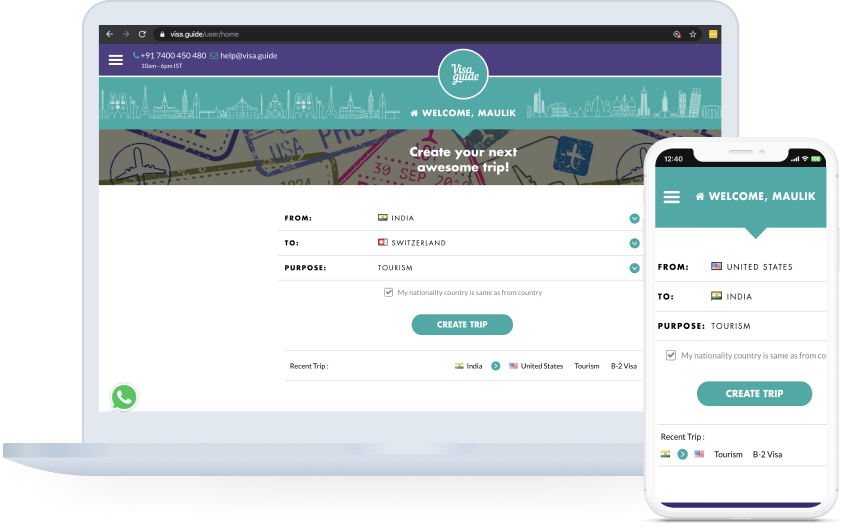
Rather than building a document-submission tool, the Ajackus team designed a full trip management system. Travellers create a trip in three structured steps — destination selection, traveller profile, and document checklist — after which the platform generates a personalised requirement checklist tracking every document and milestone across multiple travellers and multiple destinations simultaneously. Automated communication triggers deliver accurate, stage-specific updates at each workflow checkpoint, eliminating the manual follow-up that previously consumed Visa Guide’s operations team capacity.
Admin Panel and Knowledge Base
The Ajackus team built a purpose-designed admin panel that allows the Visa Guide operations team to apply any country’s updated visa requirements across the platform in under 5 minutes — a step-change from the previous manual process that required individual record edits. Alongside the admin panel, Ajackus built a full-text searchable knowledge base for the operations team, enabling instant retrieval of embassy query resolutions and reducing per-query handling time at scale.
Android Application
In parallel with the web platform, the Ajackus team built a native Android application delivering the full trip management and visa tracking experience on mobile. The application shares the same structured data layer as the web platform, giving travellers consistent, current visa intelligence and progress visibility across devices.
Results
The Visa Guide platform launched with complete coverage — 80+ countries, 21,000+ embassy records, and full workflow automation — delivering a step-change in operational capability and traveller experience simultaneously.
80+
Countries with Live Visa Data
21,000+
Embassy & Consulate Records
<5 Min
Time to Update Any Country’s Requirements
3 Steps
To Create a Multi-Destination Trip
6 Months
Full Workflow Automation Delivered
Zero
Persistent Open Document Access Links
What went well:
Operational Improvements
- Visa requirements for 80+ destination countries are now live, verified, and accessible from a single platform, eliminating the need for Indian travellers to cross-reference multiple government portals and agency sources.
- Country visa policy updates are now applied platform-wide in under 5 minutes via the structured admin panel — a critical operational capability as Visa Guide’s country coverage continues to expand.
- The searchable knowledge base enables the operations team to retrieve embassy query resolutions instantly, supporting higher application volumes without proportional headcount growth.
- Automated stage-by-stage communication across every application workflow has eliminated unstructured manual follow-up, reducing inbound customer service queries for routine status updates.
Technical Achievements
- 21,000+ embassy and consulate records catalogued, standardised, and made searchable — the most comprehensive such directory available to Indian outbound travellers within a single application.
- AWS pre-signed URL infrastructure enforces zero persistent open document links, meeting enterprise-level security requirements for confidential applicant data without adding friction to the submission experience.
- Multi-destination trip creation reduced to three structured steps, with real-time checklist tracking across all active travellers and destinations simultaneously.
- Native Android application delivers full data and feature parity with the web platform, ensuring consistent traveller experience across devices.
User Impact
- Business travellers can manage repeated multi-destination journeys using saved profiles, concurrent application tracking, and automated milestone reminders — capabilities entirely absent from previously available alternatives.
- Travellers receive accurate, automated updates at each application stage, replacing the uncertainty and anxiety of the previous manual-communication model.
- Checklist-driven trip management ensures no document or visa requirement is missed across complex multi-traveller, multi-destination applications.
Why It Worked
Full Ownership Enables Coherence
The Ajackus team took complete product ownership from day one, allowing every workstream — data layer, traveller workflows, document infrastructure, and admin tooling — to be built as a single coherent architecture. This coherence is the reason the platform launched with 80+ countries and 21,000+ records simultaneously, rather than starting with partial coverage that would have undermined the user trust the product depends on.
Security Designed In, Not Added On
Rather than treating document security as a later-stage compliance task, the Ajackus team built AWS pre-signed URL access into the platform’s core infrastructure from the outset. The deliberate choice to treat security as an architectural default means the platform is enterprise-ready without requiring retrofitting as the client base scales into corporate travel management.
Operational Tooling as a Product
Most travel-tech platforms optimise for the traveller experience and treat the operations team’s tooling as secondary. The Ajackus team built the admin panel and knowledge base as first-class products, recognising that operational speed directly determines how current and trustworthy the traveller-facing data is. The sub-5-minute country update capability is a direct product of this design priority.
Frequently Asked Questions
How does the Visa Guide platform manage verified visa data for 80+ countries?
The platform is built on a structured data layer in which every country's visa requirements are standardised to a consistent schema — covering document requirements, processing times, fee structures, embassy contacts, and eligibility conditions. Ajackus engineered a systematic ingestion and validation process to populate and maintain this layer, and a purpose-built admin panel allows the Visa Guide operations team to update any country's requirements in under 5 minutes when embassy policies change. This architecture is what makes 80+ countries of live, trustworthy data operationally maintainable at scale.
What makes document handling on the Visa Guide platform secure?
The Ajackus team implemented AWS pre-signed URLs for all document access within the platform. Pre-signed URLs generate a time-limited, access-controlled link for each specific document request — the link expires after use and cannot be accessed by any party other than the intended recipient. This means that sensitive applicant documents — passports, financial records, employment letters — are never exposed via persistent open links, meeting enterprise-level security standards without adding friction to the applicant's submission experience.
How were Visa Guide's operational workflows automated, and how long did it take?
The Ajackus team mapped Visa Guide's end-to-end application workflow — from initial trip creation through document collection, embassy submission, and status tracking — and rebuilt each stage as an automated system within the platform. Automated communication triggers send accurate, stage-specific updates to applicants at each checkpoint, eliminating the manual follow-up that previously required significant operations team time. Full workflow automation was delivered within six months of project start.
How quickly can Ajackus design and deliver a data-intensive travel platform?
The Visa Guide engagement demonstrates Ajackus's ability to deliver a full-stack, production-grade travel platform — web application, Android app, data infrastructure, and operational tooling — within a six-month automated-workflow delivery timeline. Ajackus operates across three engagement models (Team Augmentation, Managed Delivery, and Build-Operate-Transfer), with embedded engineers typically onboarding within two weeks of engagement start.
Can Ajackus build platforms where data must stay current across hundreds of constantly changing records?
Yes. The Visa Guide platform manages 80+ countries of structured visa data and 21,000+ embassy records, all of which must remain accurate as embassy policies and government requirements change. The Ajackus team designed the admin infrastructure specifically so that updates are fast and low-friction — any country's requirements can be revised in under 5 minutes — demonstrating Ajackus's approach of making operational maintenance a product feature rather than a burden.
What engagement model did Ajackus use for the Visa Guide project?
Ajackus operated under its Managed Delivery model for the Visa Guide engagement — functioning as the end-to-end engineering team rather than supplementing an existing in-house function. This model is suited to product builds where the client has deep domain expertise but requires a dedicated engineering partner to own architecture, design, and delivery. Ajackus manages sprint planning, technical decisions, and quality assurance within this model, with the client retaining full visibility and approval authority at each milestone.




Let’s Build your Project Together